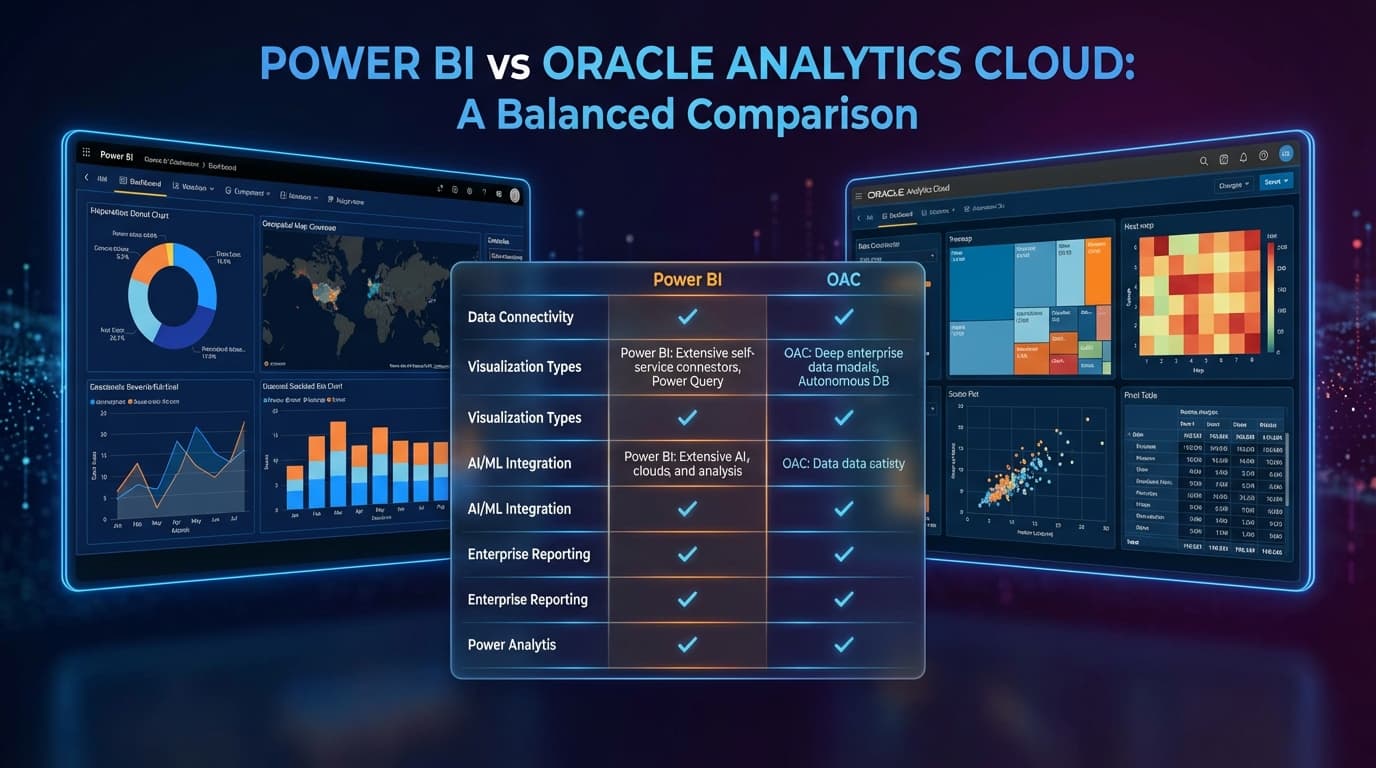
Choosing an enterprise analytics platform is one of those decisions that haunts organizations for years. Pick wrong, and you're locked into expensive licensing, frustrated users, and analytics that don't deliver. Pick right, and data becomes a genuine competitive advantage. Today we're comparing two heavyweights: Microsoft Power BI and Oracle Analytics Cloud (OAC).
This is not a feature checklist comparison—you can find those anywhere. Instead, we're sharing what we've learned deploying both platforms across DACH enterprises, including the things vendors don't mention in sales presentations.
The Honest Overview
Power BI dominates market share for good reasons: aggressive pricing, deep Microsoft 365 integration, and a genuinely excellent user experience for self-service analytics. Oracle Analytics Cloud is the underdog in market terms but has compelling strengths for organizations already invested in Oracle's ecosystem.
The best analytics platform is the one your users actually use. Everything else is expensive shelfware.
Cost Reality Check
Let's address the elephant in the room: pricing.
Power BI
- Pro: EUR 9.40/user/month (quite aggressive)
- Premium Per User: EUR 18.70/user/month
- Premium Capacity: Starts around EUR 4,700/month for P1
- Hidden costs: Premium capacity for paginated reports, serious data volumes, and embedding scenarios
Oracle Analytics Cloud
- Professional: Approximately EUR 16/user/month
- Enterprise: Approximately EUR 80/user/month
- Hidden costs: Oracle database licensing if you want optimal performance, storage costs for large datasets
The headline numbers favor Power BI, but total cost of ownership is more nuanced. Organizations with existing Oracle infrastructure often find OAC more economical when accounting for data movement and integration costs.
Where Each Platform Shines
Power BI Strengths
- Self-service excellence: Business users can genuinely build their own reports without IT help
- Microsoft ecosystem: Seamless integration with Excel, Teams, SharePoint, Azure
- Visualization quality: Modern, polished visuals out of the box
- Community and resources: Massive user community, endless tutorials, third-party visuals
- AI features: Q&A natural language queries, automated insights
Oracle Analytics Cloud Strengths
- Oracle data integration: Native, optimized connectivity to Oracle databases and applications
- Advanced analytics: Built-in machine learning, statistical analysis without separate tools
- Enterprise data preparation: Sophisticated data flows for complex transformations
- Semantic model: Centralized business definitions that ensure consistency
- On-premises option: Can run entirely on-premises for organizations with sovereignty requirements
Integration Reality
The integration story often determines platform success more than features.
Power BI Integration
Power BI connects to essentially everything, but connections are not created equal. Azure data sources work beautifully with DirectQuery. SQL Server is excellent. Other sources often require scheduled refreshes and data imports, which introduces latency and storage costs.
For organizations with Oracle as a primary data source, Power BI works but requires more architectural consideration. You're often building intermediate data layers or accepting refresh latency.
Oracle Analytics Cloud Integration
OAC obviously excels with Oracle sources—Oracle Database, Oracle ERP, Oracle HCM. The connection isn't just technical; it understands Oracle semantics and can leverage Oracle-specific optimizations.
For non-Oracle sources, OAC is adequate but not exceptional. You'll need Oracle Data Integrator or similar tools for complex integration scenarios.
The DACH Perspective
For DACH organizations, several factors matter beyond pure features:
Data Residency
Power BI offers EU data centers. OAC can run on Oracle Cloud Infrastructure in Frankfurt or Amsterdam, or entirely on-premises. For highly regulated industries, OAC's on-premises option may be decisive.
Existing Investments
Many DACH enterprises have significant Oracle investments—EBS, database licenses, Oracle Cloud applications. OAC leverages these investments. Similarly, Microsoft-centric organizations should lean toward Power BI.
Support and Expertise
Power BI expertise is easier to find and hire. OAC requires more specialized skills. Consider your internal capabilities and the local job market.
When to Choose Power BI
- Microsoft 365 is your primary productivity platform
- Self-service analytics for business users is the primary goal
- You want the lowest barrier to adoption
- Azure is your cloud platform or you're moving there
- Budget is constrained at the per-user level
When to Choose Oracle Analytics Cloud
- Oracle databases are your primary data sources
- You run Oracle ERP, HCM, or other Oracle applications
- Advanced analytics and ML are core requirements
- Data sovereignty requires on-premises deployment
- You need a centralized semantic layer for governance
The Hybrid Reality
Many enterprises don't choose—they use both. Power BI for broad self-service analytics and departmental reporting. OAC for Oracle-centric operational analytics and advanced scenarios. This isn't ideal from a cost or governance perspective, but it reflects real-world complexity.
Making the Decision
Before choosing, run a proper proof of concept with your actual data and your actual users. Vendor demos with sample data tell you almost nothing about real-world success. Test data connectivity, refresh performance, user adoption, and governance capabilities.
Need help evaluating analytics platforms for your DACH enterprise? Our team has deployed both Power BI and Oracle Analytics Cloud across industries. We can help you assess your requirements, run meaningful proofs of concept, and make a decision you won't regret.