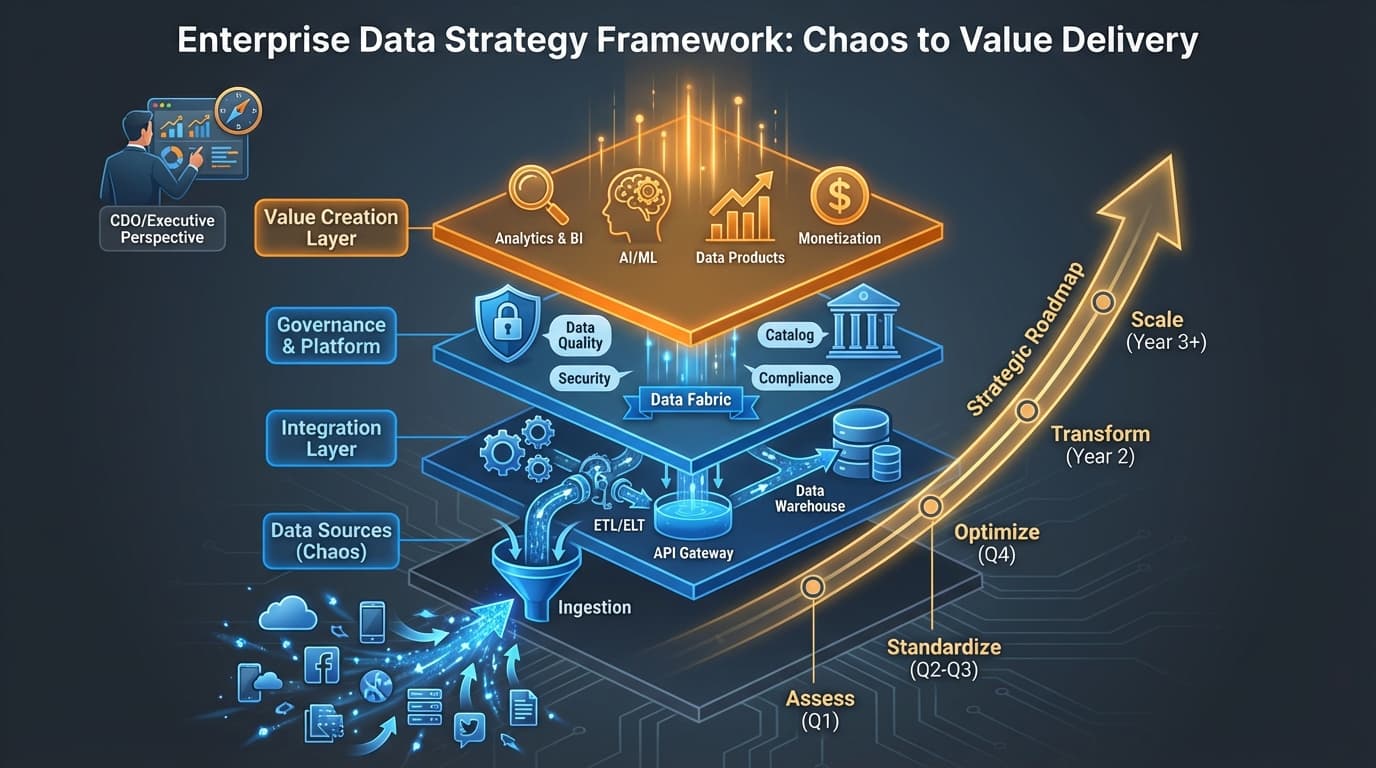
Your organization is drowning in data. Terabytes flow through your systems daily—customer interactions, operational metrics, financial transactions, IoT sensor readings. Yet when the CEO asks a seemingly simple question about customer behavior or operational efficiency, the answer takes weeks to assemble from fragmented sources. Sound familiar?
This is the data paradox facing DACH enterprises: more data than ever, less clarity than needed. The solution is not another data lake or a fancier BI tool. It is a coherent data strategy that aligns technology, people, and processes toward business outcomes.
In this guide we show how to develop a data strategy that holds up in daily operations—with four pillars, a four-phase roadmap, and a concrete example from the German Mittelstand.
Why Data Strategies Fail
Before building a framework, we need to understand why most data initiatives disappoint. After working with dozens of enterprises across Germany, Austria, and Switzerland, we see the same patterns:
- Technology-first thinking: Buying platforms before defining problems. That expensive data lake becomes a data swamp within 18 months.
- No clear ownership: Data is everyone's responsibility means it is no one's responsibility. Critical data assets have no stewards.
- Governance as bureaucracy: Heavy-handed policies that slow everything down without improving data quality.
- Missing business alignment: Data teams build sophisticated pipelines that nobody uses because they do not solve real business problems.
The best data strategy is invisible to end users—they simply get the insights they need, when they need them, without thinking about the infrastructure beneath.
The Four Pillars of Data Strategy
A successful data strategy rests on four interconnected pillars. Weakness in any one undermines the others.
Pillar 1: Business Alignment
Start with business outcomes, not technology. What decisions does your organization need to make better, faster, or more consistently? Map these decision points to data requirements.
For a manufacturing company, this might mean: "We need to predict equipment failures 48 hours in advance to schedule maintenance during planned downtime." That is a clear, measurable objective that drives specific data requirements—sensor data, maintenance history, production schedules.
Pillar 2: Data Architecture
Your architecture should enable data flow from source systems to insights with minimal friction. This includes:
- Integration layer: How data moves between systems, including real-time and batch patterns
- Storage strategy: Where data lives—operational databases, data warehouses, lakes, or lakehouses (see our overview of modern data warehousing)
- Processing framework: How raw data becomes analytics-ready information
- Consumption layer: How users access insights—BI tools, embedded analytics, APIs (for tool selection, see Power BI vs Oracle Analytics compared)
Pillar 3: Governance and Quality
Data governance gets a bad reputation because it is often implemented as bureaucratic overhead. Effective governance is different—it enables rather than restricts.
Focus on three areas: data quality (is the data accurate and complete?), data security (who can access what?), and data lineage (where did this data come from and how was it transformed?). Build lightweight processes that scale with your organization. For what this looks like day to day, see our practical guide to data governance.
Pillar 4: Organization and Culture
Technology alone cannot create a data-driven organization. You need people with the right skills, incentives that reward data-driven decisions, and a culture that values evidence over intuition.
This often means creating new roles—data product owners, analytics engineers, data stewards—and redefining how business and IT collaborate on data initiatives.
Data Ethics, GDPR, and the EU AI Act: The DACH Dimension
In the DACH region, a data strategy without a compliance foundation is not a strategy—it is a liability. Three topics belong on the agenda from day one:
- GDPR as an architecture principle: Purpose limitation, deletion concepts, and subject-access readiness are nearly impossible to retrofit into a grown data landscape. Designing them into the storage and integration layers saves expensive rework later.
- EU AI Act: As soon as data feeds AI systems, documentation and data-governance obligations apply depending on the risk class. Your data strategy should define today which data assets are AI-ready—and which are not. Why poor data quality is the most common AI blocker is covered in our analysis of data quality as the AI blocker.
- Data ethics as a trust factor: Especially in the Mittelstand, customer relationships span decades. Transparent rules about which data is used for what are not bureaucratic overhead—they are a sales argument.
Developing Your Data Strategy: A Four-Phase Roadmap
Transforming from data chaos to data-driven takes time. Here is a phased approach for CDOs and CTOs that delivers value incrementally:
Phase 1: Foundation (Months 1-3)
- Inventory existing data assets and systems
- Identify 2-3 high-value use cases with executive sponsorship
- Assess current capabilities: people, processes, technology
- Define governance principles (not detailed policies yet)
Phase 2: Quick Wins (Months 4-6)
- Deliver the first use case end-to-end
- Establish core data quality metrics and monitoring
- Build the foundational data platform components
- Create a data catalog for critical data assets
Phase 3: Scale (Months 7-12)
- Expand to additional use cases and domains
- Mature governance with data stewardship program
- Develop self-service analytics capabilities
- Build internal data literacy programs
Phase 4: Optimize (Year 2+)
- Advanced analytics and AI/ML integration
- Real-time data products for operational decisions
- Data monetization opportunities
- Continuous improvement based on metrics
A Data Strategy Example: Mittelstand Machine Builder
What does this look like in practice? A typical example from our project work: a machine builder with around 800 employees had sales data in the CRM, production data in the ERP, and service data in a homegrown system—three versions of the truth for the same machine.
- Business goal over technology: The first use case was not defined as "a data warehouse" but as "plan service deployments 48 hours earlier".
- Foundation (months 1–3): Data inventory, one data steward per domain, governance principles on two pages instead of two hundred.
- Quick win (months 4–6): An integrated machine master-data model and a first service-planning dashboard—used in production from day one.
- Result after twelve months: 30% fewer unplanned service deployments and a data foundation that now runs predictive-maintenance models.
The point: none of the technologies involved were exotic. The difference was the order—business goal, ownership, then technology.
Measuring Success
How do you know your data strategy is working? Track metrics across four dimensions:
- Business impact: Revenue influenced by data, cost savings from analytics, decision speed improvement
- Data quality: Accuracy, completeness, timeliness of critical data assets
- Adoption: Active users of analytics tools, queries per user, self-service ratio
- Efficiency: Time from question to insight, cost per analytics use case, platform reliability
Getting Started
The journey from data chaos to data-driven is not a technology project—it is a business transformation that happens to involve technology. Start small, prove value, and build momentum. The enterprises that win with data are not those with the biggest budgets or the most sophisticated tools. They are the ones that connect data investments to business outcomes and execute consistently over time.
Need help assessing your current data maturity or building a roadmap for your data strategy? Our team works with DACH enterprises to design and implement data strategies that deliver measurable results. Explore our data and analytics services—or talk to us directly.