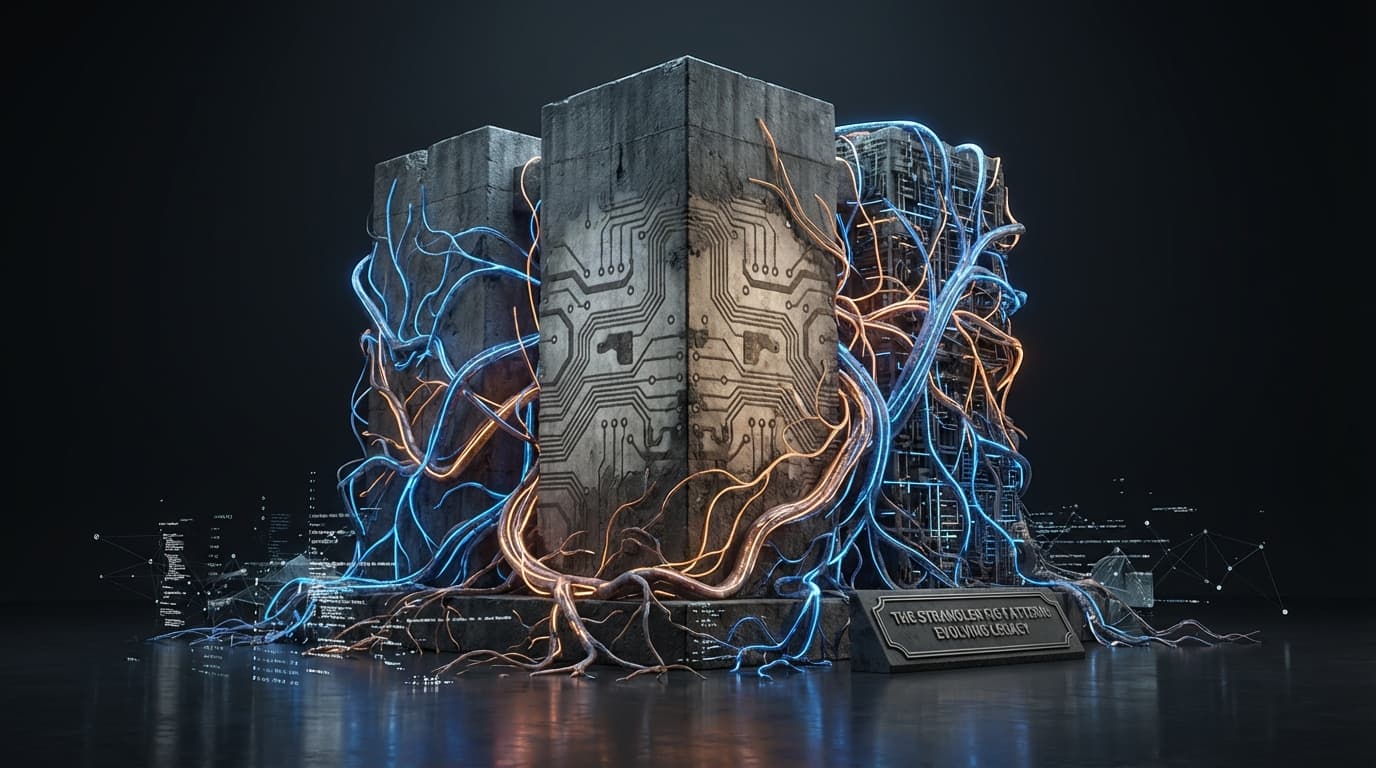
You've been told your legacy system needs to go. But the thought of a complete rewrite fills you with dread—and for good reason. Big bang migrations fail more often than they succeed. The Strangler Fig Pattern offers a safer alternative.
Why Big Bang Migrations Fail
The statistics are sobering: large-scale rewrites fail at rates between 60-80%. The reasons are predictable:
- Underestimated complexity in the legacy system
- Business can't pause for 18-24 month rewrites
- Requirements change during long projects
- Integration points are harder than expected
- Institutional knowledge is lost during the transition
What Is the Strangler Fig Pattern?
Named after a tropical plant that gradually grows around a host tree, the Strangler Fig Pattern replaces systems incrementally. New functionality is built in modern technology while the legacy system continues operating. Over time, the new system "strangles" the old one until it can be decommissioned.
How It Works
Step 1: Establish the Facade
Create an API gateway or facade in front of your legacy system. All traffic flows through this layer, giving you control over routing.
Step 2: Identify Seams
Find natural boundaries in your system where functionality can be extracted. Good candidates have clear inputs/outputs and limited dependencies.
Step 3: Build New Components
Implement extracted functionality in your modern stack. The new component should be production-ready before routing traffic to it.
Step 4: Route Traffic Gradually
Start with a small percentage of traffic. Monitor carefully. Increase gradually until 100% flows through the new system.
Step 5: Repeat
Extract the next component. Continue until the legacy system handles nothing—then decommission it.
Benefits of This Approach
- Reduced risk: Each migration is small and reversible
- Continuous delivery: Business gets value throughout, not just at the end
- Learning opportunities: Each iteration teaches you about the system
- Flexibility: Priorities can shift without throwing away work
- Parallel operation: Legacy continues serving users during transition
Real-World Example
A financial services client had a 15-year-old core banking system. Instead of a risky rewrite, we:
- Implemented an API gateway in front of the legacy system
- Built a new customer portal that called the gateway
- Gradually moved services behind the gateway to modern microservices
- Completed the migration over 18 months with zero downtime
The business continued operating normally throughout—something impossible with a big bang approach.
When to Use the Strangler Fig Pattern
This pattern works best when:
- The legacy system is large and complex
- Business continuity is critical
- You can implement a routing layer
- Team can work on both systems temporarily
Start Your Modernization Journey
Legacy modernization doesn't have to be all-or-nothing. The Strangler Fig Pattern lets you reduce risk while delivering continuous value. Ready to plan your modernization? Let's discuss your system and identify the right approach.