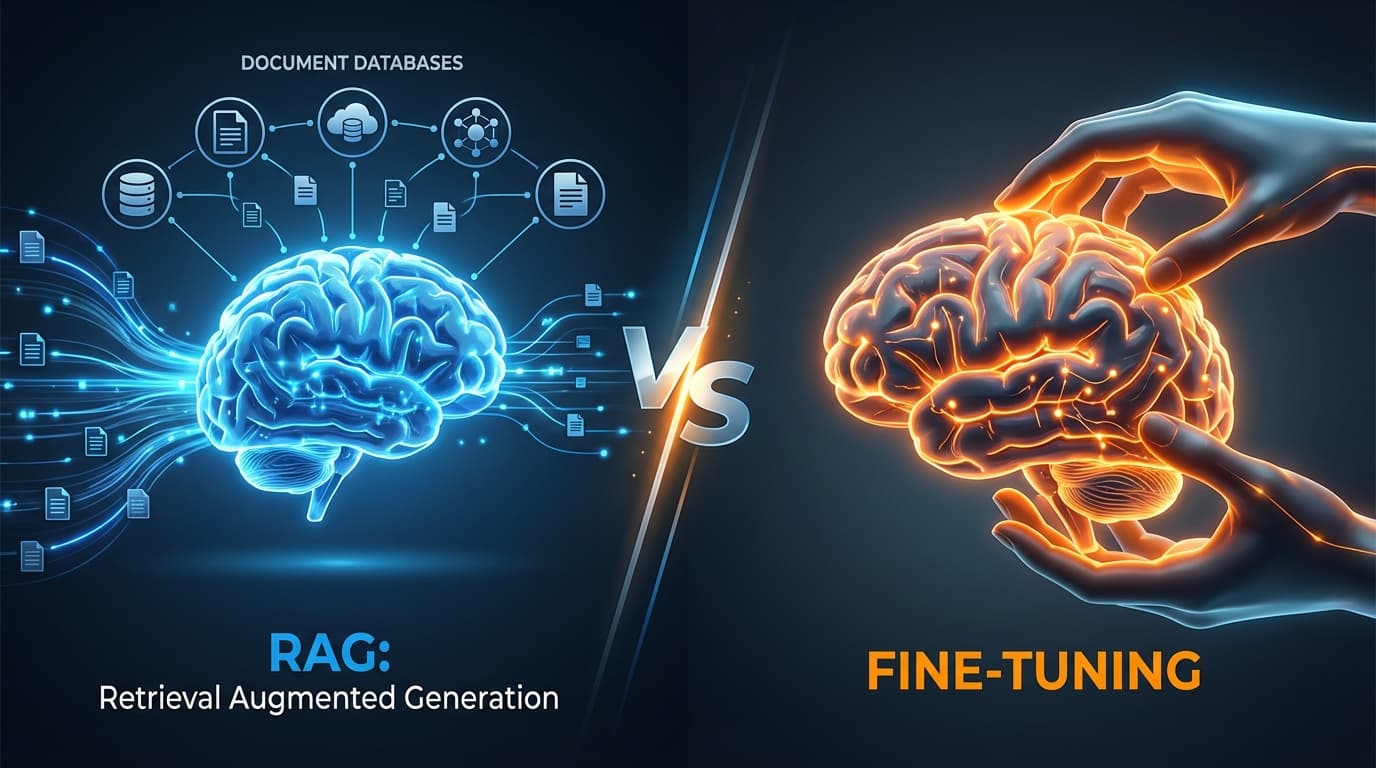
You've decided to build an AI solution that uses your company's knowledge. Now comes the critical question: Should you use Retrieval-Augmented Generation (RAG) or fine-tune a model on your data? The wrong choice can cost months of development time and significant budget. Here's how to decide.
Understanding the Two Approaches
Before diving into the comparison, let's clarify what each approach actually does.
RAG: Teaching AI Where to Look
RAG connects a language model to your knowledge base. When users ask questions, the system retrieves relevant documents and feeds them to the AI along with the question. The AI generates answers based on this retrieved context.
Think of it like giving someone a reference library and asking them to answer questions by looking things up.
Fine-Tuning: Teaching AI How to Think
Fine-tuning modifies the AI model itself by training it on your specific data. The knowledge becomes embedded in the model's weights. The AI learns your terminology, style, and domain patterns.
Think of it like sending someone to school to become an expert in your field.
When to Choose RAG
RAG is typically the better choice when:
- Your knowledge changes frequently: Product catalogs, documentation, policies that update regularly
- Accuracy is critical: RAG can cite sources, making it easier to verify and audit answers
- You need quick deployment: RAG can be implemented in weeks, not months
- Data volume is large: RAG handles millions of documents efficiently
- Budget is limited: No expensive GPU training required
When to Choose Fine-Tuning
Fine-tuning makes sense when:
- You need a specific style or tone: Brand voice, technical writing standards
- Domain expertise is required: Legal, medical, or highly specialized terminology
- Performance must be optimized: Fine-tuned models can be faster for specific tasks
- Structured outputs are needed: Consistent JSON, specific formats
- Knowledge is stable: Core concepts that rarely change
The Hybrid Approach: Best of Both Worlds
Many successful implementations combine both approaches:
- Fine-tune a model to understand your domain language and output requirements
- Use RAG to provide current, specific information
- The fine-tuned model better interprets retrieved context
This hybrid approach delivers domain expertise with up-to-date accuracy.
Cost and Timeline Comparison
Here's a realistic comparison for enterprise implementations:
- RAG Implementation: 4-8 weeks, €30,000-€80,000
- Fine-Tuning: 2-4 months, €80,000-€250,000
- Hybrid Approach: 3-5 months, €100,000-€300,000
These ranges vary significantly based on data complexity, integration requirements, and scale.
Decision Framework
Ask yourself these questions:
- How often does my knowledge base change? (Frequently → RAG)
- Do I need verifiable, source-cited answers? (Yes → RAG)
- Is domain-specific language critical? (Yes → Fine-tuning)
- What's my timeline? (Short → RAG)
- What's my budget? (Limited → Start with RAG)
Your Next Step
The right choice depends on your specific use case, data, and business requirements. We help enterprises evaluate their options and implement the approach that delivers results. Ready to discuss your AI strategy? Let's talk.