Every enterprise integration project starts with good intentions. Connect System A to System B. Simple. Fast. Done. But fast-forward five years, and you're staring at a tangled web of 200+ point-to-point connections that nobody fully understands—and everyone fears to touch. Welcome to integration debt, the silent killer of enterprise agility.
The Point-to-Point Trap
Point-to-point integration seems efficient at first. Direct connections. Minimal overhead. Quick wins. But the math turns against you fast. With n systems, you potentially need n(n-1)/2 connections. Ten systems? 45 possible integrations. Fifty systems? 1,225. Each one a potential failure point, a security vulnerability, a maintenance burden.
We see this pattern repeatedly in DACH enterprises. The ERP talks directly to the CRM. The CRM has a custom integration with the marketing platform. Finance built their own connector to the banking interface. Every department "solved" their integration need—and collectively created an unmaintainable mess.
The cost of point-to-point isn't the first integration. It's the hundredth. And by then, you're trapped.
What Makes an API Strategy "Strategic"
An API strategy isn't just documentation for your REST endpoints. It's a business capability framework that treats APIs as products, not projects. Strategic API design considers consumers, versioning, governance, and evolution from day one.
The four pillars:
- Business alignment: APIs expose business capabilities, not database tables
- Consumer-centric design: Design for how APIs will be used, not how data is stored
- Lifecycle management: Plan for versioning, deprecation, and evolution
- Governance without bureaucracy: Standards that enable, not obstruct
The API-First Architecture Pattern
API-first means designing the interface before the implementation. It's a mindset shift from "build the system, then expose some endpoints" to "define the contract, then build to fulfill it." This inversion changes everything.
When DACH enterprises adopt API-first, we see three consistent benefits: faster partner integrations (contracts are already defined), better internal reuse (capabilities are discoverable), and cleaner system boundaries (APIs force you to think about domains).
Implementation principles:
- Define OpenAPI specifications before writing code
- Mock APIs for parallel frontend/backend development
- Generate client SDKs automatically from specifications
- Validate implementations against contracts in CI/CD
Building the API Platform Layer
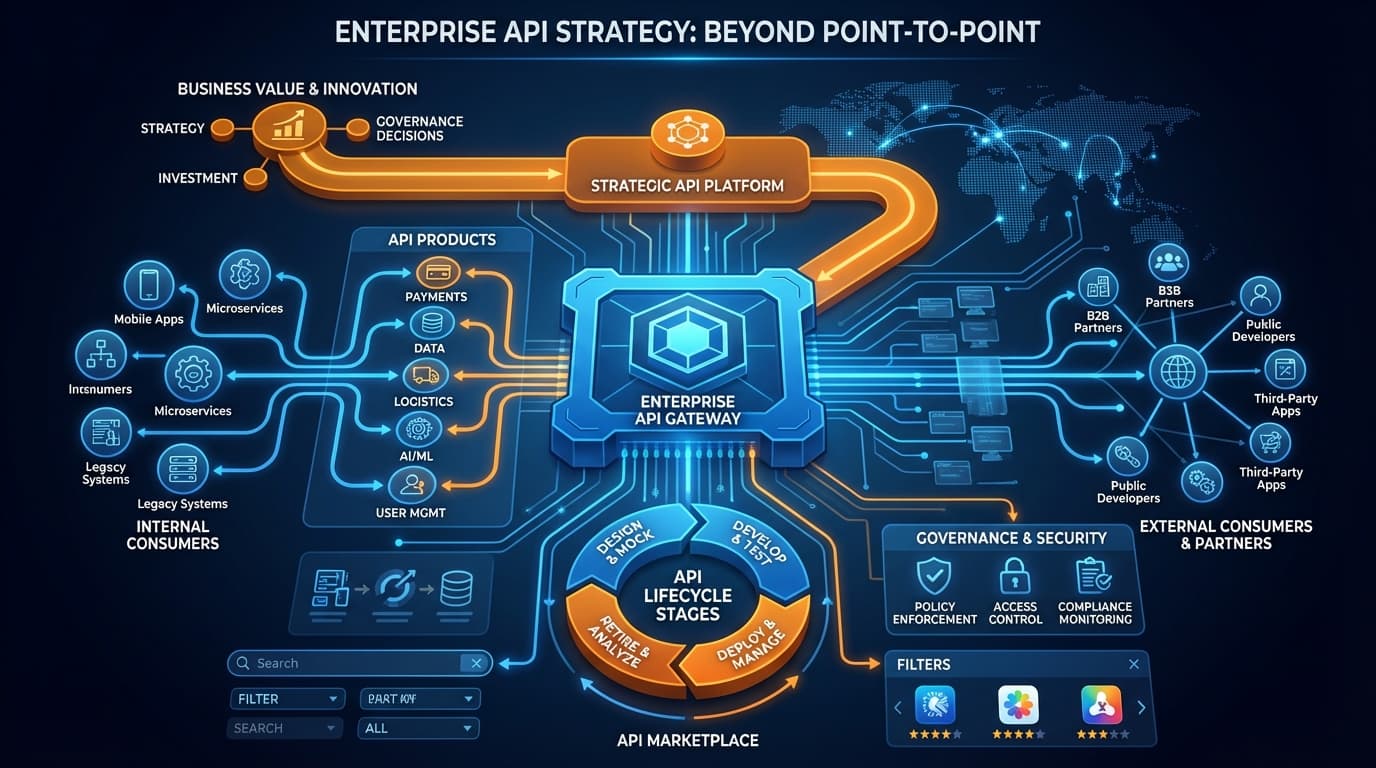
Between your systems and their consumers sits the API platform—gateway, developer portal, analytics, and management. This layer provides the infrastructure that makes APIs manageable at enterprise scale.
A German manufacturing company we worked with reduced API-related incidents by 60% after implementing proper gateway policies. Rate limiting prevented runaway integrations from overwhelming systems. Authentication standardization eliminated the security gaps from custom auth implementations.
Essential platform capabilities:
- API Gateway: Single entry point with security, throttling, and routing
- Developer Portal: Self-service discovery, documentation, and onboarding
- Analytics: Usage patterns, performance metrics, and business insights
- Lifecycle Management: Versioning, deprecation schedules, and consumer notifications
Versioning Without Breaking Everything
APIs evolve. Business requirements change. The question isn't whether you'll need to version—it's how to do it without breaking existing consumers. This is where many enterprises stumble.
Semantic versioning (major.minor.patch) combined with proper deprecation policies gives consumers predictability. Major versions break compatibility (and should be rare). Minor versions add features. Patch versions fix bugs. Simple in theory, but requires discipline in practice.
The best API versioning strategy is one your consumers can predict. Surprises are for birthdays, not production integrations.
Governance That Enables
API governance has a reputation for bureaucracy. Review boards. Approval workflows. Month-long waits. But governance done right accelerates delivery by providing guardrails, not gates.
Automated governance through API linting catches common issues before code review. Style guides ensure consistency without manual enforcement. Self-service provisioning with appropriate guard rails enables teams to move fast within defined boundaries.
Effective governance includes:
- Automated style checks: Spectral or similar tools in CI/CD
- API design templates: Starter specifications for common patterns
- Security baselines: Non-negotiable authentication and authorization standards
- Documentation requirements: APIs without docs don't get published
The Business Case for API Investment
CFOs want numbers. Here's what we consistently see in DACH enterprises after API strategy implementation:
- Integration time reduction: 40-60% faster new integrations
- Maintenance cost decrease: 30% reduction in integration-related support
- Partner onboarding acceleration: Days instead of months
- Developer productivity: Reusable APIs compound efficiency gains
Starting Your API Transformation
You don't need to boil the ocean. Start with high-value, high-traffic integrations. Identify your most painful point-to-point connections and design strategic APIs to replace them. Build the platform incrementally as you migrate workloads.
The enterprises succeeding with APIs aren't the ones with the most sophisticated technology. They're the ones treating APIs as business assets—designed deliberately, managed professionally, and evolved continuously.